
Build Your Own Company “Knowledge Brain” (RAG) vs. Renting ChatGPT: A Clear Guide for Enterprise Leaders
Imagine you’re deciding where your company should operate.
Option A: You rent a beautiful, fully furnished space. You can move in today.
Option B: You buy land and build your own office. It takes longer, but you own it.
That’s the simplest way to understand the choice:
– Ready-to-go AI tools (ChatGPT, Claude, Manus, and similar) are like renting.
– Building your own “company knowledge brain” (often called RAG) is like owning.
This matters most when the “thing” you’re putting inside the building is your business knowledge—your playbooks, proposals, contracts, product docs, customer history, and internal decisions. That is your IP (your secret sauce). Enterprises don’t just want quick answers. They want an asset that gets stronger every year.
—
Ready-to-go tools (ChatGPT, Claude, Manus, etc.)
Think of these like a smart assistant you can hire instantly.
– You ask questions.
– You paste in some context.
– You get an answer.
First, what are you really comparing?
It’s fast and impressive—especially for general tasks like writing, brainstorming, or summarizing non-sensitive text.

Building your own “company library + AI helper” (RAG)
Think of this as building a private company library, then putting a helpful librarian on top.
– The library holds your company documents and knowledge.
– The librarian (AI) answers by pulling the right pages from your library.
Instead of trying to cram your whole business into a single chat box every time, your system can “go find the right pages” and respond based on your real internal materials.
—
The simple scorecard: Rent vs Own
Below is a plain-language comparison you can use to make a decision.
—
1) Your business IP: is it becoming an asset—or just passing through?
If you use ready-to-go tools
Your company knowledge is often handled like this:
– Someone copies a policy, a customer note, or a contract into a chat.
– The tool gives an answer.
– Next week, someone else does it again.
That’s not building an asset. It’s more like showing your files to a helpful outsider whenever you need them.
There’s also a real “boardroom risk” feeling here: you’re sending business context outside your walls (even if the vendor has privacy rules). Business leaders in regulated or high-stakes environments often find this unacceptable for core knowledge.
If you build your own RAG-style system
Your documents and know-how become a durable company resource:
– One shared knowledge foundation
– Used by many teams
– Improved over time
It’s like turning scattered binders and random shared folders into a real “company brain” you own. That’s why enterprises treat this like infrastructure, not a toy.
—
2) The “token” problem: the toll booth you hit when you scale
Here’s a simple way to think about “tokens” (without the math):
Tokens are like a taxi meter for AI. The more you feed it and the more it writes back, the more you pay—and the more likely you are to hit usage limits.
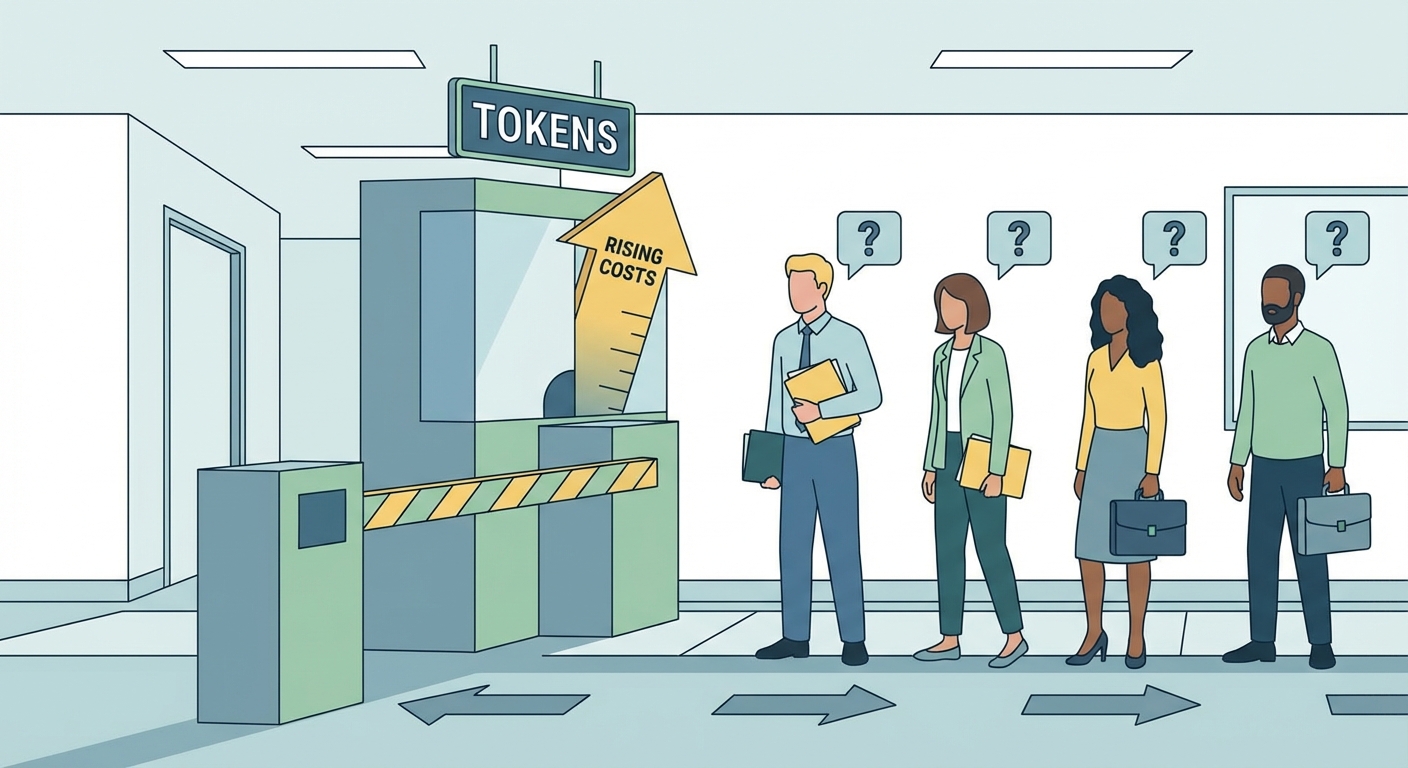
Ready-to-go tools have “how much it can read” limits
When teams try to use ChatGPT or Claude for real company work, they often run into problems like:
– A long policy doesn’t fit in one go
– Multiple contracts won’t fit together
– The tool trims or summarizes, and details get lost (aka memory problem)
– People split the work into pieces, which creates inconsistent answers
This is the same as trying to run a growing restaurant from a tiny food truck. It works—until it doesn’t.
Some subscriptions can even stop working when you hit limits—right when you need them most. That’s a painful way to run a business process.
RAG avoids “stuffing the whole library into the chat”
With RAG, the AI doesn’t try to hold everything at once. It:
– finds the most relevant pages
– uses those pages to answer
So instead of forcing your team to keep re-pasting the same big documents, the system retrieves what matters. This scales far better as your company knowledge grows.
—
3) Vendor lock-in: getting stuck in one landlord’s building
Ready-to-go tools can trap you
Many companies start small:
– a few power users
– a few useful prompts
– a few workflows
Then it spreads. Soon, the team depends on it.
That’s when the “landlord problem” shows up:
– prices change
– terms change
– features change
– your security team blocks a tool
– a better tool appears—but switching becomes painful
You can’t easily “move out,” because what you built is tied to that specific vendor’s way of working.
With RAG, you can swap the engine without replacing the whole car
When your knowledge lives in your system, the AI model is more like a replaceable engine.
If a new provider becomes better, cheaper, or safer, you can change the AI layer without losing your company knowledge foundation. This gives enterprises negotiating power and flexibility.
—
4) Migration: “Can we move later?” (Often: not cleanly)
Ready-to-go tools are hard to migrate away from
Teams discover they can export chats, but:
– chat logs aren’t a clean knowledge base
– prompts don’t always work the same elsewhere
– workflows don’t transfer neatly
So “switching” can feel like “starting over.”
RAG is designed to be moved and upgraded
Because your knowledge is stored and organized by you, changing AI providers is closer to:
– changing the engine
not
– rebuilding the whole vehicle
That’s a big deal for long-term strategy.
—
5) Team-wide scale: one answer across the company (not 50 different answers)
Ready-to-go tools are great for individual productivity
But enterprises often need more than “help me write an email.” They need:
– consistent answers across departments
– one definition of key terms (like “qualified lead”)
– controlled access (Sales shouldn’t see HR docs)
– confidence that everyone is using the latest policy
Ready-to-go tools struggle to become a shared, governed company system.
RAG supports “one company, many teams”
With a shared knowledge foundation, you can:
– roll it out across the team
– control who can see what
– keep answers aligned with real internal documents
This turns knowledge into something closer to a company nervous system—available everywhere, but with the right guardrails.
—
When should you rent (use ready-to-go tools)?
Ready-to-go tools are a smart choice when:
– you need quick results today
– the work is general (writing, brainstorming)
– you are not using sensitive internal information
– you’re still learning what use cases matter
They’re like renting a meeting room for a day: perfect for speed.
—
When should you own (build RAG)?
Building your own company knowledge brain is a smart choice when:
– your knowledge is valuable IP
– you need to scale to many teams
– you want predictable costs as usage grows
– you want control and flexibility in the future
– you can’t afford vendor dependency for core workflows
For enterprises, this is often not optional. It’s how you protect what makes your business special, and how you build an advantage that compounds year after year.
—
A simple decision question for CEOs
Ask one question:
“If we spend money on this for 3 years, will we own something valuable at the end?”
– With ready-to-go tools, you mostly own habits and workflows—and a bill.
– With RAG, you own a growing knowledge asset that can power the whole company.
That’s why, for many enterprises, RAG is the “must-go” path for anything tied to business IP and long-term scale.
—
Practical next step (no jargon)
If you’re not sure, take a hybrid approach:
1) Use ready-to-go tools for low-risk tasks (writing, first drafts, ideas).
2) Build your company knowledge brain for high-value, sensitive, repeatable work (policies, product truth, customer support, internal playbooks).
That way, you get quick wins now—while building an owned asset for the future.







Wrap your code in
<code class="{language}"></code>tags to embed!